
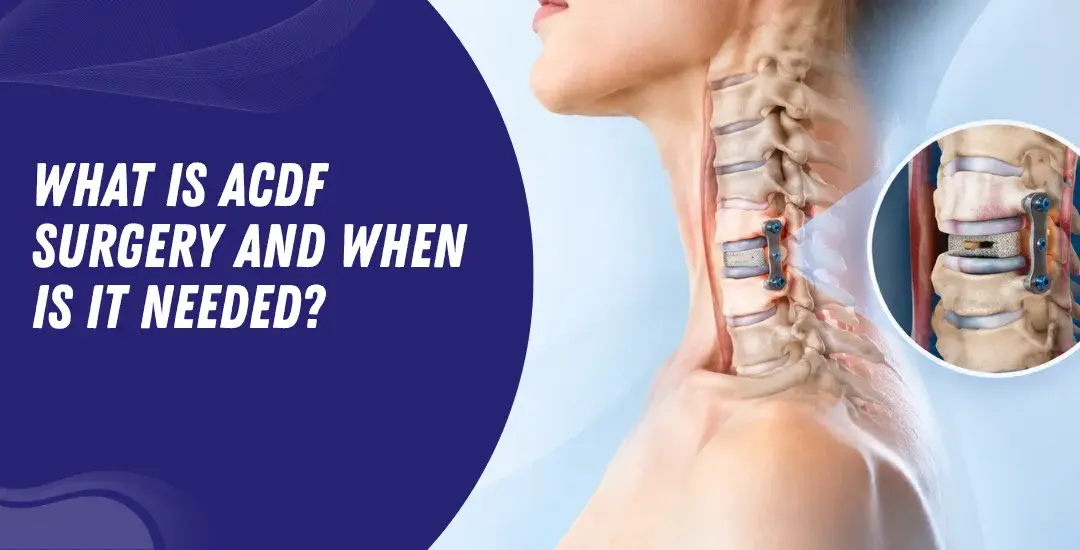
ACDF stands for Anterior Cervical Discectomy and Fusion. It is a neck surgery that goes in through the front of the throat to remove a damaged disc or bone spur pressing on the spinal cord or nerves. Once the disc is out the adjacent vertebrae are fused together to keep the spine stable. It is one of the most performed anterior cervical disc surgeries for conditions that have not responded to conservative care.
According to Dr. Arvind Umarani, Spine Surgeon, “ACDF is not the starting point. It comes after physio and injections have had a proper trial. When nerve function is slipping or the arm pain won’t move, that is when cervical ACDF surgery earns its place.”
Experiencing neck pain radiating into your arm?
What Does the ACDF Procedure Involve?
The surgery goes in through the front of the neck. That approach reaches the disc directly without disturbing the spinal cord.
Disc removal and decompression: The damaged disc or bone spur compressing the nerve is taken out. This is where the relief comes from.
Graft placement: A bone graft or cage fills the space where the disc was. It maintains the height between the vertebrae and gives the fusion something to build on.
Plate and screw fixation: A small titanium plate locks the treated level in place while the bone fuses.
Fusion over time: The vertebrae fuse gradually over three to six months. Most patients are mobile within a day or two.
For anterior cervical disc surgery and how these approaches compare, the cervical laminectomy surgery page covers what each procedure involves.
When Is ACDF Surgery Actually Needed?
Not every cervical disc problem ends here. These are the situations where surgery becomes the right call.
Cervical radiculopathy that won’t settle: Arm pain or numbness from a compressed nerve root that has not improved after six to eight weeks of conservative care.
Cervical myelopathy: Cord compression causing weakness or grip problems. This doesn’t wait for physio to run its course.
Significant disc herniation on MRI: Structural compression that matches the clinical picture and hasn’t responded to treatment.
Instability at the disc level: Abnormal movement between vertebrae that keeps putting the cord or nerves at risk.
For patients comparing ACDF with posterior decompression, what happens during a cervical laminectomy covers the differences in approach and recovery.
Why Choose Dr. Arvind Umarani?
Dr. Arvind Umarani is a fellowship-trained orthopedic spine surgeon with advanced cervical spine training from fellowships in South Korea, Japan, and India. His approach starts with a genuine trial of conservative care. When ACDF is the right call he plans around the specific disc level and the patient’s needs. Not a fixed template. Patients get a straight answer on whether their spine problem needs surgery and which approach fits it best.
Frequently Asked Questions
1. What is cervical ACDF surgery?
A procedure that removes a damaged cervical disc and fuses the adjacent vertebrae.
2. When is ACDF surgery recommended?
When neck or arm symptoms from a cervical disc do not improve after conservative care.
3. How long is recovery after anterior cervical disc surgery?
Light activity typically resumes in four to six weeks with full recovery around three months.
4. Does ACDF surgery affect neck movement?
It reduces movement at the fused level but neighbouring segments typically compensate over time.
References:
Disclaimer: The information in this blog is intended for general awareness and educational purposes only. Please consult a qualified spine surgeon for personalised guidance regarding your condition.
