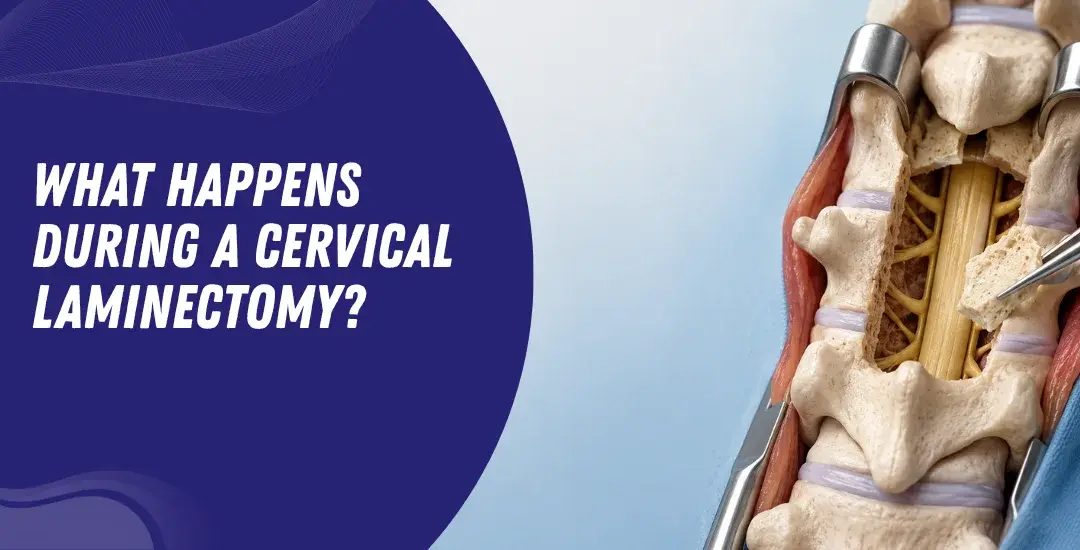
Each vertebra in the neck has a bony segment at the back called the lamina. When it starts narrowing the spinal canal, it presses on the cord or nerve roots and causes arm weakness, numbness, and grip problems. A surgical laminectomy takes that section out to clear the pressure. It’s most commonly done for cervical stenosis, myelopathy, or nerve compression that hasn’t moved with conservative treatment.
According to Dr. Arvind Umarani, Spine Surgeon, “A cervical laminectomy isn’t the first option. It comes after conservative management has had a genuine trial. When the cord’s under real pressure and neurological function is slipping, removing the lamina is the most direct way to stop further damage.”
Experiencing arm weakness or neck-related nerve symptoms?
What Does a Cervical Laminectomy Procedure Actually Involve?
The surgeon works from the back of the neck, not the front. That one difference shapes how much muscle gets disturbed and how the recovery goes.
Positioning and anaesthesia: The patient lies face down under general anaesthesia. The neck gets stabilised throughout. Given how close the work is to the spinal cord, that’s non-negotiable.
Incision and muscle retraction: A midline incision runs down the back of the neck. The paraspinal muscles on each side are moved apart to reach the vertebrae without cutting through them.
Lamina removal: The lamina and, usually, the ligamentum flavum beneath it come out at the affected level or levels. That’s what creates space. The canal gets wider, the cord gets room, and the compression lifts.
Fusion if needed: Not every case stops at decompression. If there’s instability or several levels are involved, lateral mass screws and rods go in too. Because a decompressed spine still needs to be a stable one.
The steps involved and patient criteria are covered on the cervical laminectomy surgery page.
Who Actually Needs This Surgery, and When Is It Recommended?
Not every neck problem ends here. But some presentations do cross a threshold where surgery is the only thing left that makes sense.
Cervical spondylotic myelopathy: Cord compression from degenerative cervical spine changes. Weakness, coordination issues, trouble walking. The most common reason this surgery gets recommended.
Multi-level stenosis: Canal narrowing across three or more levels needs broader decompression than most anterior approaches allow. A posterior neck laminectomy handles that better.
Failed conservative management: Physio, medications, injections, tried properly over time, with no real gains. Or the patient continues to worsen despite all of it.
Progressive neurological deficit: Grip, sensation, fine motor control, all actively getting worse. And waiting at that stage doesn’t help anyone.
For patients comparing surgical approaches for spine decompression, biportal vs open spine surgery is worth reading alongside this.
Why Choose Dr. Arvind Umarani?
Dr. Arvind Umarani is an orthopedic spine surgeon with advanced training in minimally invasive disc surgery through fellowships in South Korea, Japan, and India. His practice covers the full range of posterior cervical techniques, from decompression alone to laminectomy with lateral mass fixation, guided by neuromonitoring and navigation throughout. Patients get a straight answer on whether surgery fits their situation, and which approach actually suits their spine.
Frequently Asked Questions
1. What does a surgical laminectomy remove?
The lamina, a bony arch sitting at the back of each vertebra in the neck.
2. What conditions does cervical laminectomy treat?
Cervical stenosis, myelopathy, radiculopathy, and cord compression are the most common.
3. How long is the hospital stay after a neck laminectomy?
Two to three days for most, depending on how many levels were treated.
4. What are the early warning signs that cervical surgery may be needed?
Grip weakness, arm numbness, or coordination problems that keep getting worse.
References:
Disclaimer: The information in this blog is intended for general awareness and educational purposes only. Please consult a qualified spine surgeon for personalised guidance regarding your condition.
