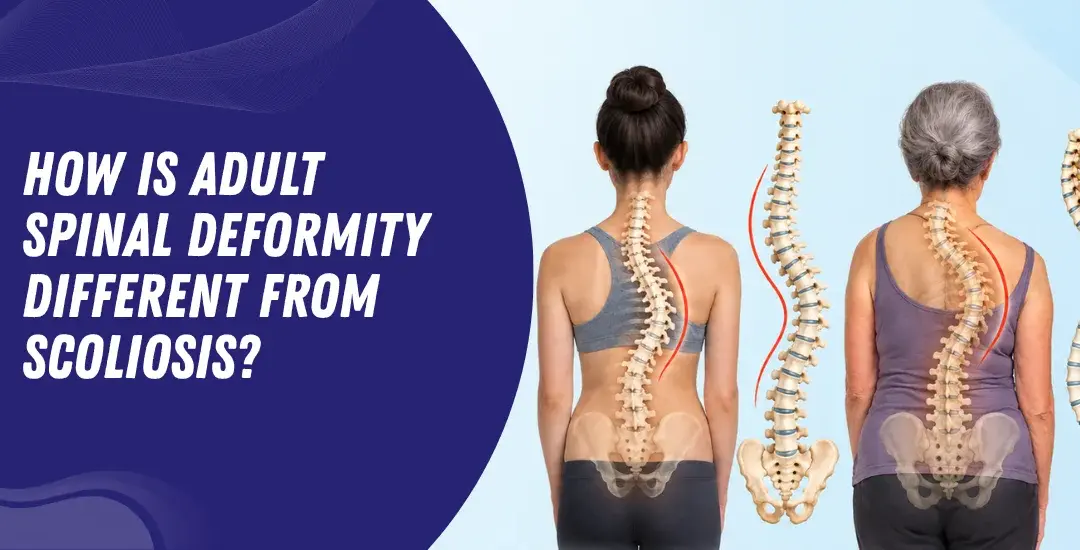
Adult spinal deformity is a broad term. It covers any abnormal spinal alignment in a skeletally mature adult, and scoliosis is just one type within it. A lateral curve. The wider category pulls in kyphosis, sagittal imbalance, and degenerative malalignment that tends to show up in midlife. Related terms. Not the same thing.
According to Dr. Arvind Umarani, Spine Surgeon, “People treat scoliosis and spinal deformity as synonyms and they are not. Scoliosis is a coronal plane curve. Adult spinal deformity takes in sagittal balance, rotation, and pelvic compensation too. Miss that and the treatment plan is incomplete.”
Want to understand whether your spine alignment needs further assessment?
What Makes Adult Spinal Deformity Broader Than Scoliosis?
Adult spinal deformity doesn’t just involve a sideways curve. It spans three planes of spinal alignment. These four components are what actually separate it from a scoliosis diagnosis.
Sagittal imbalance: The spine tips forward. No sideways curve involved at all. Disc degeneration, vertebral collapse, or flatback from a previous fusion tend to sit behind it.
Coronal imbalance: The trunk shifts sideways relative to the pelvis. That whole-trunk shift is what matters here, not just the Cobb angle.
Rotational deformity: Vertebrae twist around their axis as the curve builds. Foraminal narrowing and nerve compression tend to follow in adult cases.
Pelvic compensation: The pelvis tips and rotates to make up for the malalignment above it. Pelvic parameters factor heavily into adult back deformity planning, far more than they do in adolescent scoliosis.
Patients looking at surgical options for spinal curvature will find that the scoliosis surgery page goes into operative planning and what correction involves.
What Symptoms Tell Them Apart in Practice?
The presenting picture is where the difference becomes most apparent clinically. Both can be asymptomatic early but the serious presentations diverge.
Scoliosis carried from adolescence: The curve was there long before symptoms showed up. Over time, as disc and facet degeneration builds around it, pain and nerve involvement come into the picture.
Adult degenerative back deformity: Typically begins as low back pain and difficulty walking any distance because of stenosis. The deformity itself often comes up on a scan after the patient came in for something else.
Sagittal imbalance: The patient can’t stand upright comfortably and fatigues quickly. The problem is spinal balance not just curvature.
Neurological symptoms: Leg weakness, claudication, and nerve root pain. These appear much more in adult spinal deformity than in straightforward adolescent scoliosis.
The blog on 30 degree scoliosis curve covers how curves are graded and what a moderate presentation actually looks like on imaging.
When Does Spinal Deformity Actually Need Treatment?
Conservative care handles a lot of adult spinal deformity. But there are points where it stops being sufficient. These are the thresholds that shift the decision.
Progressive pain and disability: Back and leg pain that just keeps building, getting through physio and injections without shifting. Once it starts cutting into daily function it’s a different conversation entirely.
Neurological deterioration: Weakness, numbness, or bladder changes on a downward trend. Rest doesn’t reverse them and they don’t sit still.
Radiographic progression: Repeat imaging shows the curve or sagittal imbalance is advancing. A deformity that’s still moving needs a plan not just monitoring.
Failed conservative care: Structured non-surgical care across several months and still no meaningful ground gained. That’s where spinal deformity correction surgery enters the conversation.
The blog on bracing or surgery for scoliosis walks through how that decision gets made for patients navigating that specific question.
Key Takeaways: Scoliosis is a lateral spinal curve. Adult spinal deformity is broader, taking in kyphosis and sagittal imbalance as well. Getting treatment right means looking past the curve to balance, pelvic alignment, and what’s happening neurologically.
Frequently Asked Questions
1. What is adult spinal deformity?
Any abnormal spinal alignment in a skeletally mature adult covering scoliosis, kyphosis, and sagittal imbalance.
2. Is scoliosis the same as adult spinal deformity?
No. Scoliosis is just one back deformity type. Adult spinal deformity is the wider category.
3. When does back deformity require spinal deformity correction surgery?
When pain becomes disabling, neurological symptoms develop, or non-surgical care fails to maintain function.
4. Can adult spinal deformity develop without prior scoliosis?
Yes. Disc degeneration can cause back deformity in adults with no prior scoliosis history.
References:
- PMC — Adult degenerative scoliosis: challenges in diagnosis, pain management, and surgical decision-making: https://pmc.ncbi.nlm.nih.gov/articles/PMC13384435/
- PMC — Rehabilitation in adult spinal deformity: https://pmc.ncbi.nlm.nih.gov/articles/PMC7557622/
Disclaimer: This blog is for educational purposes only. Consult a qualified spine surgeon for personalised guidance.
