
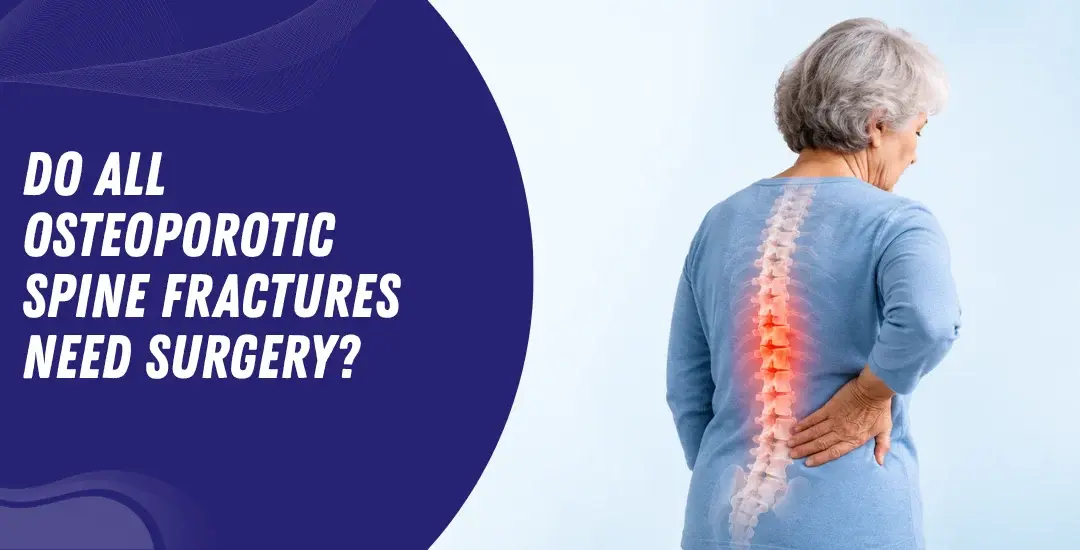
Not all of them. Most osteoporotic fractures are compression fractures where bone that has already lost density gives way under a fairly ordinary amount of load. The spine doesn’t shatter. It settles. And for most patients that settling eventually stops on its own given time, support, and the right management. Surgery only enters the equation when the fracture doesn’t follow that path.
According to Dr. Arvind Umarani, Spine Surgeon, “Most patients expect surgery after an osteoporotic fracture. They rarely need it. The spine can heal well with proper support and bone treatment. Surgery only enters the picture when pain hasn’t shifted after six to eight weeks, imaging shows ongoing collapse, or neurological signs appear.”
Want to understand whether your fracture needs surgery or conservative management?
How Are Most Osteoporotic Fractures Managed Without Surgery?
Most patients reach the other side of this without an operation. The path there runs through four consistent steps.
Rest and activity modification: Complete bed rest isn’t the answer and actually delays recovery. The goal is cutting out movements that load the fractured level while keeping the patient mobile enough to avoid deconditioning. Light walking from early on is encouraged.
Pain management: Anti-inflammatories handle most acute pain. When oral medication isn’t touching it a nerve block gives the patient enough relief to start moving again.
Spinal bracing: A brace holds the fractured level and limits further collapse during healing. Recovery with bracing runs six to twelve weeks on average though it shifts depending on how much height was already lost.
Bone density treatment: The fracture is a symptom. The bone quality is the underlying problem. Starting osteoporosis medication during recovery cuts the risk of a second fracture before this one has healed.
For cases where surgical intervention does become necessary, the MIS TLIF surgery page covers what that path involves.
When Does a Fracture Actually Need Surgery?
Past a certain point waiting stops helping. These four scenarios cross that line.
Persistent severe pain: Six to eight weeks of proper conservative management and pain hasn’t shifted. Imaging confirms the fracture hasn’t consolidated. The evidence for waiting runs out here.
Neurological symptoms: A collapsed vertebra pressing on the cord or nerve root means leg weakness or bladder problems. That can’t wait.
Progressive vertebral collapse: Follow-up scans show the vertebra still collapsing despite bracing and rest. The structural situation is getting worse and the window for a simple procedure is closing.
Spinal instability: The fracture has destabilised the segment to the point where normal everyday load can’t be borne safely. The spine needs fixation not just time.
For patients wanting to understand how spine surgeons assess whether any spinal condition actually warrants an operation, what happens during a cervical laminectomy offers useful context on how surgical decisions are approached and explained.
What Surgical Options Exist?
When surgery is needed for osteoporotic bone the approach is almost always minimally invasive. Open fusion carries too much risk here.
Vertebroplasty: Bone cement goes in through a needle under imaging guidance. Pain drops quickly and no large incision is involved.
Kyphoplasty: A balloon inflates inside the collapsed space first to recover height. Cement follows. Better for deformity than vertebroplasty on its own.
Posterior stabilisation: Screws and rods go in when instability or nerve compromise rules out cement alone. Recovery is longer but in those cases nothing else holds the spine.
Cement-augmented pedicle screws: Standard screws don’t grip in osteoporotic bone. Cement fills the gaps in the cancellous structure and anchors the construct properly.
For patients also managing disc-related nerve symptoms alongside osteoporotic spine changes, when does a herniated disc actually need surgery covers how those decisions differ and where the thresholds sit.
Key Takeaways: Most osteoporotic spine fractures heal without surgery. Fracture surgery comes into play when pain persists past six to eight weeks, neurological signs appear, or structural instability sets in. Vertebroplasty or kyphoplasty comes before any more complex fixation.
Frequently Asked Questions
1. Do all osteoporotic spine fractures need surgery?
No. Most heal with rest, bracing, and proper bone treatment without any operation.
2. What is vertebrae fracture recovery time without surgery?
Six to twelve weeks with conservative treatment for most patients.
3. When does an osteoporotic fracture need fracture surgery?
When pain stays unresolved after conservative care, neurological deficit develops, or the spine becomes unstable.
4. What is kyphoplasty in osteoporotic fracture treatment?
A needle delivers bone cement into the fractured vertebra to stabilise it and relieve pain.
References:
- PMC — Osteoporotic vertebral fractures: an update: https://pmc.ncbi.nlm.nih.gov/articles/PMC12266666/
- PubMed — Osteoporosis: The Renascent Impact of Vertebral Fractures: https://pubmed.ncbi.nlm.nih.gov/42452496/
Disclaimer: This blog is for educational purposes only. Consult a qualified spine surgeon for personalised guidance.
