
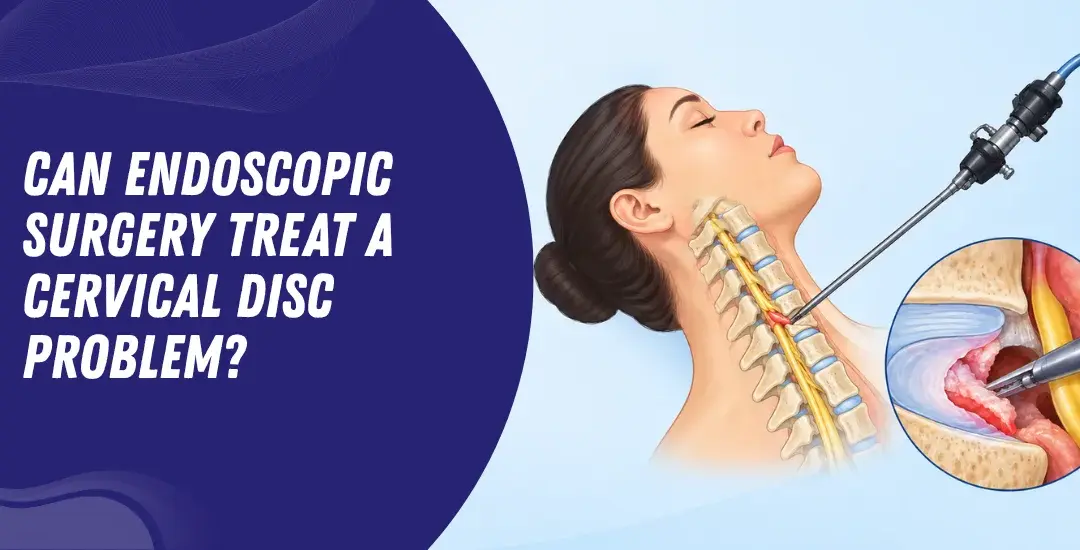
Endoscopic surgery can treat a cervical disc problem, especially a soft disc that’s pressing on one nerve and sending pain, tingling or weakness down your arm. Suitability depends on your MRI and how much physiotherapy and tablets have helped. A calcified disc or an unstable neck needs a different operation.
According to Dr. Arvind Umarani, Spine Surgeon, “Endoscopic cervical discectomy works best when one soft disc presses on one nerve at the level of the symptoms. If the scan does not explain the pain, no technique will fix it.”
Want to know whether your neck and arm symptoms need an MRI review?
How Does Endoscopic Cervical Discectomy Work?
A thin tube with a small camera reaches the disc. The neck muscles are moved aside, not cut.
- Small incision: The skin opening is about 5 millimetres from the front and 1 centimetre from behind.
- Front or back approach: Soft discs near the centre are reached from the front. Discs toward the nerve exit suit the back, where a little bone is trimmed.
- What comes out: Only the disc fragment pressing on the nerve.
- Fusion: The front route normally needs no fusion, sparing neighbouring levels extra strain.
The endoscopic surgery page lists what else this approach covers. The scan decides the route.
Who Is a Candidate for Endoscopic Cervical Discectomy?
Not every disc suits this approach. The surgeon checks four things.
- Arm symptoms: The pain runs down one arm. A tingling thumb and index finger usually mean the C6 nerve.
- Matching MRI: The MRI must show a soft disc pressing on the nerve behind the symptoms.
- Earlier treatment: Most patients have had six to twelve weeks of physiotherapy and medication first.
- Cases that do not fit: A hard calcified disc cannot be pulled through a small tube. An unstable neck or squeezed cord needs fusion or laminectomy.
Our guide on who is a good candidate for endoscopic spine surgery covers these checks. Read it before booking.
Can Minimally Invasive Surgery Treat Cervical Spinal Stenosis?
Sometimes. It’s a different problem, because the whole spinal canal has become tight.
- Several causes: A bulging disc is rarely alone, as bone spurs and thick ligaments narrow the canal too. Removing one fragment rarely solves the problem.
- Endoscopic option: A one centimetre incision at the back has been used at up to three levels. Follow up data is still short.
- Warning signs: Dropping things or stumbling can mean the spinal cord is being squeezed. They need a prompt specialist review.
- Open surgery: A canal tight at several levels is opened from the back in a laminectomy, with fusion if the neck is unstable.
With one or two tight levels on the MRI, minimally invasive cervical spinal stenosis surgery may be possible. With many, the surgeon advises cervical laminectomy surgery.
Key Takeaways: Endoscopic cervical discectomy is meant for one soft disc pressing on one nerve. When the MRI and symptoms agree, it can relieve arm pain through a small incision. Most front approaches avoid fusion. A calcified disc, stenosis or an unstable neck calls for another plan.
Frequently Asked Questions
1. Is general anesthesia needed for endoscopic cervical discectomy?
Front approaches often need only sedation. Back approaches usually use general anesthesia.
2. Does endoscopic cervical discectomy need fusion?
Usually no, as the front approach removes the fragment without fusing the spine.
3. Can endoscopic surgery treat cervical spinal stenosis?
Sometimes, when few levels are narrow. Many narrow levels usually need open surgery.
4. When should I see a doctor urgently?
See a doctor the same day for weakening hands, trouble walking or bladder changes.
References:
- PMC: Endoscopic Spine Surgery of the Cervicothoracic Spine: A Review of Current Applications: https://pmc.ncbi.nlm.nih.gov/articles/PMC9421277/
- PMC: Full endoscopic cervical spine surgery: https://pmc.ncbi.nlm.nih.gov/articles/PMC7340839/
Disclaimer: This blog is for educational purposes only. Consult a qualified spine surgeon for personalised guidance.
