
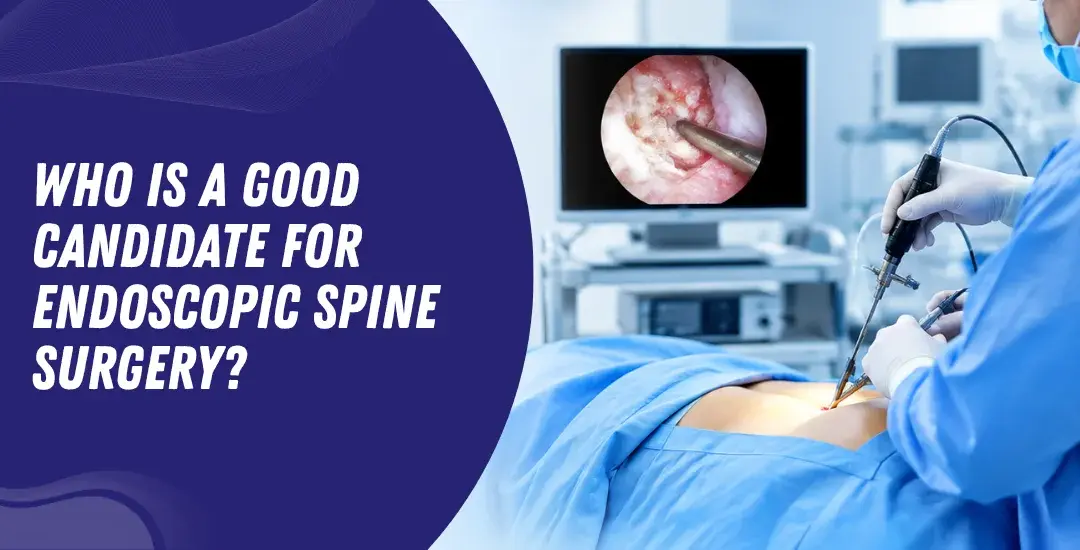
Minimally invasive endoscopic spine surgery suits patients with a clearly diagnosed nerve compression problem that has not responded to six to twelve weeks of conservative care. Think herniated disc or spinal stenosis with symptoms radiating into the limbs. Stable spine. Specific pathology on MRI. That is the profile this approach was built for.
According to Dr. Arvind Umarani, Spine Surgeon, “Patient selection is everything with endoscopic surgery. Get that right and the outcomes rival open surgery. Get it wrong and you have a technique that was never going to work for that spine problem.”
Wondering if you qualify for endoscopic spine surgery?
What Makes Someone a Good Candidate?
The MRI is a starting point. These are the factors that actually decide suitability.
Confirmed pathology on imaging: Disc herniation or canal narrowing that shows up clearly on MRI. Vague back pain without a structural cause is not an indication for the endoscopic technique.
Failed conservative care: Physio and injections tried properly for six to twelve weeks with no real improvement. That is when minimally invasive endoscopic spine surgery becomes the next step worth discussing.
Radiating symptoms: Sciatica or arm pain from a compressed nerve root. These match the pathology the endoscopic approach is designed to fix.
Stable spine: Single or two-level disease without significant instability. The moment multilevel fusion enters the picture a different approach is needed.
Age is rarely the barrier: Older patients often benefit most. Lower surgical stress and faster recovery make endoscopic surgery workable where open surgery carries more risk.
For conditions treated and how the procedure works, the endoscopic spine surgery page covers it in detail.
Who May Not Be Suitable?
Some spine problems genuinely need open surgery. Knowing when not to use the endoscopic technique matters as much as knowing when to.
Severe instability or multilevel fusion requirements sit outside what endoscopy handles well. Spinal deformity, tumours, and infections with widespread involvement fall in the same category.
No MRI correlate: If symptoms do not match a nerve distribution and the scan does not show a structural cause, the endoscopic approach will not fix it.
Previous complex surgery at the same level needs careful reassessment. Not all revision cases are excluded but the decision needs more than a standard MRI review.
To understand how endoscopic surgery stacks up against open options, biportal vs open spine surgery breaks that decision down clearly.
Why Choose Dr. Arvind Umarani?
Dr. Arvind Umarani is a fellowship-trained orthopedic spine surgeon with UBE biportal endoscopic training under Prof. C.W. Park in South Korea and advanced spine fellowships in India and Japan. His practice covers the full range of minimally invasive endoscopic spine surgery from monoportal discectomy to biportal decompression and MIS-TLIF, backed by published comparative research in peer-reviewed journals. Patients get a straight answer on whether they are the right candidate for the endoscopic technique or whether a different approach fits better.
Frequently Asked Questions
1. Who is a good candidate for minimally invasive endoscopic spine surgery?
Someone with confirmed nerve compression who has tried conservative care without improvement.
2. What conditions make you suitable for the endoscopic technique?
Disc herniation, spinal stenosis, sciatica, and foraminal compression are the most common indications.
3. Can elderly patients have endoscopic spine surgery?
Yes, lower surgical stress and faster recovery make it well suited for older patients.
4. What are the signs a herniated disc needs surgery urgently?
Loss of bladder or bowel control means emergency surgery is needed immediately.
5. What rules you out as a candidate for this surgery?
Severe spinal instability, advanced deformity, or multilevel fusion requirements are typical exclusions.
References:
Disclaimer: The information in this blog is intended for general awareness and educational purposes only. Please consult a qualified spine surgeon for personalised guidance regarding your condition.
