
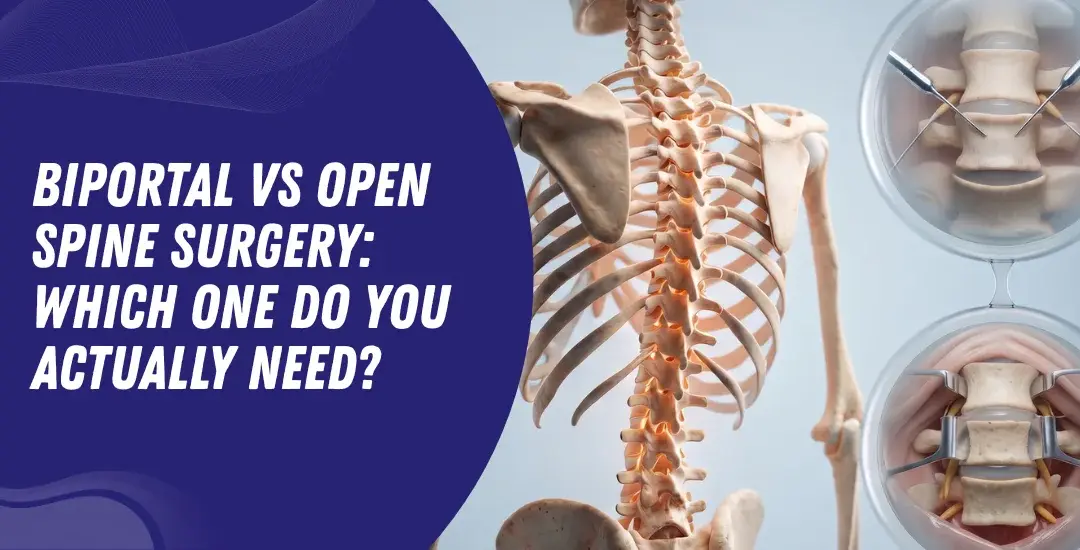
Open spine surgery is the conventional route: one larger incision that gives the surgeon a direct, unaided view of the spine. Biportal endoscopic surgery, also called Unilateral Biportal Endoscopy (UBE), takes a different path. It uses two tiny incisions, usually under a centimeter each, one carrying a high-definition camera and the other the surgical instruments, so the spine is treated through a magnified screen view instead of an open field. Which one sounds more advanced isn’t really the question. What matters is your specific spine problem, how many levels it involves, and how much correction it needs. Dr. Arvind Umarani lays out when biportal fits, and when open surgery is still the safer call.
According to Dr. Arvind Umarani, leading spine surgeon in Bangalore, “Patients often ask for the endoscopic option by name. My job is to check whether their spine problem actually suits it. Biportal works well for the right pathology. A wide, multilevel deformity may still need an open approach. The technique should fit the disease, not the other way round.”
Not sure whether your spine needs biportal or open surgery?
How Do Biportal Endoscopic and Open Surgery Differ?
Same target, two very different routes in, and that’s what shapes recovery.
Factor | Biportal Endoscopic | Open Spine Surgery |
Incision and access | Two portals, under 1 cm each | One larger incision, wider muscle exposure |
Muscle disruption | Works between muscle planes | Detaches more soft tissue to reach the spine |
Visualisation | HD endoscope, fluid-assisted magnified view | Direct line of sight |
Recovery and hospital stay | Often mobile within hours | Longer stay, slower return to activity |
Incision and access: Two portals under a centimeter each against one bigger cut. That gap alone changes how much tissue gets disturbed.
Muscle disruption: Biportal slides between the muscle planes. Open surgery has to move through them.
Visualisation: The endoscope gives a magnified, fluid assisted view. Open surgery works off direct sight, no screen.
Recovery: Biportal patients are often up and walking within hours. Open surgery means a longer stay, and a slower climb back to normal.
For a single-level disc problem, a microscopic lumbar discectomy does the job with similar precision.
Which Approach Is Right for Your Spine Condition?
The better technique fits the pathology and the patient. Not the reverse.
Single-level disc disease: Biportal suits focal disc herniation and lateral recess stenosis well.
Multilevel or deformity cases: Wide multilevel decompression and deformity work often still needs open surgery for control and stability.
Bone quality and anatomy: Severe instability or distorted anatomy can make open access the safer bet, even with the longer recovery.
Patient priorities: Faster recovery and smaller scars pull patients toward biportal. Suitability still comes first though.
Beyond disc problems, endoscopic spine surgery covers a broader range of spinal conditions worth understanding on its own.
Why Choose Dr. Arvind Umarani?
Dr. Arvind Umarani trained under Prof. C.W. Park in South Korea for UBE biportal endoscopic surgery, on top of advanced spine fellowships in India and Japan. His practice covers the full spread, biportal, monoportal endoscopic decompression, microscopic discectomy, MIS-TLIF, all backed by published comparative research in peer-reviewed spine journals. What patients get is a straight, honest comparison of endoscopic and open options for their specific spine problem.
Frequently Asked Questions
1. Is biportal endoscopic spine surgery better than open surgery?
Yes, for suitable cases like disc herniation, but not for every spine problem.
2. What conditions can biportal endoscopic surgery treat?
Disc herniation, lateral recess stenosis, and select spine decompressions in suitable patients.
3. Is open spine surgery still necessary?
Yes, for multilevel disease, deformity, or instability needing wider surgical access.
4. How much faster is recovery after biportal surgery?
Many patients mobilise within hours and go home sooner than with open surgery.
References:
Disclaimer: The information shared in this content is for educational purposes and not for promotional use.
