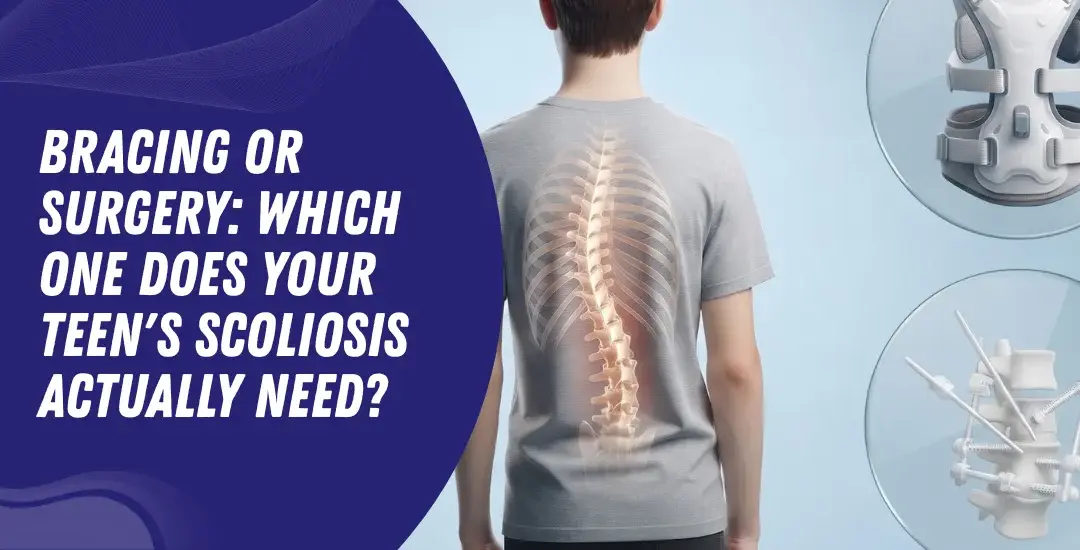
Whether a teen with adolescent idiopathic scoliosis needs bracing or surgery depends entirely on curve severity, measured in degrees, and skeletal maturity, meaning how much growing is still left. For moderate curves sitting between 25 and 45 degrees, bracing is typically the first step, used to stop progression before surgery becomes a conversation. Surgery gets reserved for the more severe end. Curves past 45 to 50 degrees, or a curve that keeps climbing even with a brace on. Dr. Arvind Umarani lays out exactly where that line sits.
According to Dr. Arvind Umarani, Orthopedic Spine Surgeon, “Bracing works when there’s growth left and the scoliosis curve is still moderate. Cross a certain Cobb angle, or watch it keep climbing despite a brace, and surgery stops being optional. It becomes the only way to protect the spine long term.”
Not sure if your teen needs a brace or surgery for scoliosis?
Bracing vs Surgery for Adolescent Idiopathic Scoliosis: What's the Real Difference?
Two treatment paths, very different in how they work and what they ask of the patient.
| Feature | Bracing | Surgery |
| Cobb Angle Range | 20 to 40 degrees | Above 45 to 50 degrees |
| Skeletal Maturity | Works best with growth remaining | Considered regardless of remaining growth |
| Treatment Goal | Slow or halt progression | Correct the curve and fuse the spine |
| Recovery Time | No downtime, worn daily | 5 to 7 days in hospital, months to full recovery |
| Long-Term Outcome | Prevents further progression, doesn’t reshape the existing curve | Achieves lasting correction and spinal balance |
On the Cobb angle: A brace holds ground on moderate curves, nothing more. Past 45 to 50 degrees, it just can’t keep pace.
On skeletal maturity: A brace needs growth to work with. Once the plates close, that same curve often ends up needing surgery.
On the actual goal: Bracing buys time, nothing else. Surgery goes for a corrected, fused, stable spine.
On recovery: A brace fits into daily life, no downtime at all. Scoliosis surgery is different. It needs a real recovery window before things go back to normal.
When the table above points toward surgery, scoliosis surgery is planned based on the exact curve pattern and what it requires.
When Does Adolescent Idiopathic Scoliosis Cross Into Surgical Territory?
Bracing has its limits. Past a certain point, no orthosis holds a spine in place.
Curve beyond 45 to 50 degrees: Most surgeons stop debating at this point and start planning instead.
Progression despite full brace compliance: The brace was worn right, and the number still climbed. That’s a red flag, not a reason to push the brace harder.
Breathing or posture takes a hit: Once chest wall compression sets in, this stops being cosmetic and becomes functional.
Skeletally immature with a fast moving curve: A growing teenager with a steep, active curve doesn’t have much time to spare.
Spine problems don’t always stop at deformity. For issues beyond scoliosis, endoscopic spine surgery is worth knowing about too.
Why Choose Dr. Arvind Umarani?
Dr. Arvind Umarani is a fellowship-trained orthopedic spine surgeon, with dedicated training in adult and paediatric spinal deformity from South Korea and Japan. His practice covers the whole decision path for adolescent idiopathic scoliosis. Monitoring, bracing, navigation-guided correction, spinal fusion, all of it, backed by published comparative research on deformity correction in peer-reviewed journals. What patients and parents actually get is a straight answer: brace or surgery, and why.
Frequently Asked Questions
1. At what Cobb angle is scoliosis surgery usually recommended?
Most surgeons consider surgery once the curve exceeds 45 to 50 degrees.
2. Can bracing stop scoliosis progression completely?
Bracing slows or halts progression in many cases but does not correct it.
3. Does a brace hurt or restrict a teenager's activities?
Most teens adjust within weeks and continue school, sports, and daily activities normally.
4. Is scoliosis surgery safe for a growing child?
Yes, with neuromonitoring and modern navigation, complication rates remain low in experienced hands.
References:
Disclaimer: The information shared in this content is for educational purposes and not for promotional use.
